What North Richland Hills landlords need to know about biohazard cleanup laws
Texas law puts most biohazard cleanup on the landlord, not the tenant. Here is who pays, what your insurance covers, and what remediation costs in 2026.
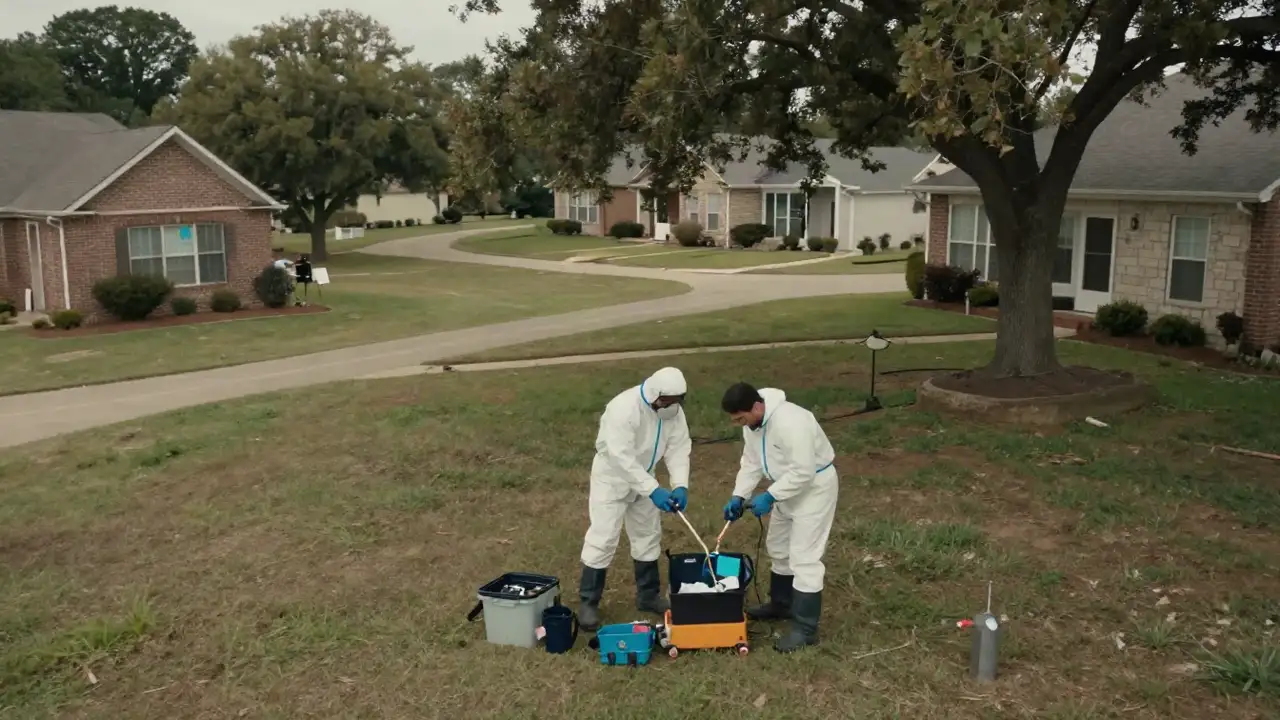
In North Richland Hills, the landlord pays for biohazard cleanup in almost every case - not the tenant, and not the tenant's family. Texas law treats blood, bodily fluids, decomposition, hoarding waste, and chemical contamination as conditions that make a rental unit untenantable, and the Texas Property Code puts the duty to restore a habitable unit squarely on the property owner. That is true whether the tenant caused the situation or a guest did.
What follows is the practical version of those rules: who is responsible, what your insurance actually pays, what remediation costs in 2026, and the mistakes that turn a $2,000 job into a $12,000 one.
Who is legally responsible for biohazard cleanup in a North Richland Hills rental?
North Richland Hills landlords biohazard cleanup laws come down to one principle: you own the unit, so you own the contamination. A tenant can be liable for the damage they caused, but that liability is a debt you chase after the fact - it does not transfer the legal duty to make the unit safe again. The City of North Richland Hills can cite a property under its nuisance and substandard structure ordinances long before any civil case resolves.
Three parties can end up involved, and they are not interchangeable:
- The landlord - holds the legal duty to deliver a habitable unit and to remediate contamination between tenancies.
- The tenant - may owe money for negligence, but rarely has the cash to cover a full remediation.
- The remediation contractor - the only party that can produce documentation showing the unit was made safe.
If you own rentals near Biohazard Cleanup in North Richland Hills Town Center, where a lot of the housing stock dates to the 1970s and 1980s, you also inherit porous subflooring, original particleboard cabinets, and HVAC systems that pull airborne contaminants into every room. Older construction raises the remediation cost because more material has to come out.
What Texas law actually requires of landlords
Texas does not have a single statute titled "biohazard cleanup law." The obligations are spread across the Property Code, health and safety rules, and local ordinance. Texas Property Code § 92.052 requires a landlord to repair a condition that materially affects the physical health or safety of an ordinary tenant. Blood, decomposition fluid, sewage backup, and hoarding-related contamination all meet that threshold.
Two more pieces matter. Property Code § 92.056 gives the tenant a formal notice-and-repair path, and § 92.0563 allows a tenant to recover damages plus one month's rent and attorney's fees if you ignore it. Separately, Texas Health and Safety Code Chapter 341 sets sanitation standards that apply to any dwelling, rented or not.
Practically, that means the clock starts the day you are notified. If a tenant reports a suicide, an unattended death, or a sewage backup in the unit, you have a legal duty to act, and you have a business reason to act fast - every day the unit sits empty is a day of lost rent in a market where a two-bedroom near Loop 820 rents for $1,500 to $1,900 a month.
What Texas law does not require is that you personally do the cleaning. It requires that the condition be corrected. That distinction is why landlords hire a licensed remediation firm and keep the paperwork.
When a tenant's lease or renters policy shifts the cost
A well-written lease can shift the financial burden back to the tenant, but it cannot shift the legal duty. If your lease says the tenant is responsible for damage caused by their negligence, that clause supports a claim in small claims court - it does not let you leave a contaminated unit occupied or re-rent it without remediation.
Two documents do most of the work:
- The lease - a clause requiring the tenant to maintain renters insurance and to reimburse the owner for damage beyond normal wear and tear.
- The tenant's renters policy - most Texas renters policies include loss-of-use and liability coverage that can pay for remediation when the tenant is at fault.
In practice, renters insurance pays out on a minority of these jobs. Most tenants who cause a biohazard event - a hoarding situation, an overdose, a pet-related contamination - either carry no policy or let it lapse. Plan on your own coverage being the primary source of funds, and treat any tenant reimbursement as a bonus.
Does landlord insurance cover biohazard cleanup in North Richland Hills TX?
Sometimes, and less often than most landlords assume. A standard Texas landlord policy (DP-3) covers sudden and accidental discharge - a sewage line that backs up, a water heater that fails and floods a room. It typically excludes gradual damage, intentional acts, and contamination that built up over months.
Here is what we see on real claims:
- Sewage backup - covered only if you bought the backup endorsement, which runs $50 to $150 a year on most policies.
- Suicide or unattended death - usually excluded as an intentional act or under a pollution/contamination exclusion.
- Hoarding cleanup - almost always excluded; insurers classify it as tenant neglect, not a covered peril.
- Meth or fentanyl residue - excluded under pollution and illegal-activity provisions.
Call your carrier before you sign a remediation contract. If the adjuster is going to be involved, we document the loss the way adjusters want it - photos before anything is moved, moisture readings, material logs, and a written scope - so the claim does not get denied on a technicality. Landlords we work with on Biohazard Cleanup in Hurst and the surrounding mid-cities run into the same exclusions, so the documentation standard is identical across the area.
What professional biohazard cleanup costs in 2026
Typical 2026 pricing in the North Richland Hills area runs $1,200 to $3,500 for a contained single-room event and $5,000 to $15,000 or more when structural material has to be removed. The number that drives the invoice is not the size of the room - it is how much porous material has to be cut out and replaced.
Rough ranges we quote:
- Blood or bodily fluid on hard surfaces - $800 to $2,000.
- Single-room unattended death with subfloor removal - $2,500 to $6,500.
- Full-unit hoarding or decomposition - $6,000 to $20,000, including disposal.
- Odor treatment after structural work - $500 to $2,500 depending on square footage and HVAC involvement.
Compare that to the alternative. A unit that sits vacant for 90 days at $1,700 a month costs you $5,100 in lost rent, plus the risk of a city citation and a tenant who talks. Remediation is almost always the cheaper path.
We give you a flat number before we start, and it does not change unless we open a wall and find something the inspection could not see.
Common mistakes North Richland Hills landlords make
The most expensive mistake is trying to clean it yourself. Household bleach does not penetrate subfloor, drywall, or the foam backing under carpet, and it does not kill the bacteria that cause odor weeks later. We get called to re-clean roughly one in five jobs where a landlord already tried.
Other mistakes we see repeatedly:
- Waiting on the police report. Law enforcement releases the scene to you, not to the tenant. You can start remediation as soon as the scene is released - you do not need to wait for a case to close.
- Throwing out contaminated material before documenting it. Once it is in the dumpster, the insurance claim gets harder.
- Re-renting after a visual inspection. Odor and residue come back after the first warm week. Get clearance documentation.
- Skipping the HVAC. If the unit ran its air handler during the event, the ductwork is contaminated and every future tenant will smell it.
- Handling it as a normal turnover clean. A standard cleaning crew is not equipped or insured for bloodborne pathogens, and their general liability policy will not cover a biohazard loss.
If the situation involves a death, the job is usually larger than it first looks. Our Unattended Death Cleanup North Richland Hills TX crews handle the scene, the structural removal, and the odor work as one scope so you are not coordinating three contractors.
When to call a professional
Call a professional the moment the contamination involves blood, bodily fluids, decomposition, sewage, hoarding waste, or any unknown chemical. Those are the categories where a standard cleaning crew cannot legally or safely finish the job, and where your liability as the owner is highest.
BioNexa Services handles biohazard remediation across North Richland Hills and the mid-cities. We work directly with landlords, property managers, and estate attorneys, we document the loss for your carrier, and we give you a written clearance record you can keep in the file for the next tenant. If you are not sure whether the situation needs remediation, send us photos and we will tell you straight.
Frequently Asked Questions
What do North Richland Hills landlords need to know about biohazard cleanup laws?
The landlord holds the legal duty to remediate, regardless of who caused the contamination. Texas Property Code § 92.052 requires you to fix conditions that affect health or safety, and North Richland Hills can cite the property under its nuisance ordinance. Tenant reimbursement is a separate civil matter.
Who is responsible for biohazard cleanup in a rental property in North Richland Hills TX?
The property owner is responsible for getting it done. A tenant can be financially liable for negligence, and their renters insurance may pay, but neither removes your duty to restore the unit. Expect to fund the work and pursue reimbursement afterward.
Are landlords required to hire professional biohazard cleanup in North Richland Hills?
No statute names a specific contractor, but the work must meet sanitation standards and be documented. In practice that means a licensed remediation firm - household cleaning cannot reach subfloor, drywall, or ductwork, and it leaves no clearance record for your file.
Does landlord insurance cover biohazard cleanup in North Richland Hills TX?
It covers sudden events like sewage backup if you carry the endorsement, which costs $50 to $150 a year. It usually excludes suicide, unattended death, hoarding, and drug residue. Check your pollution and intentional-act exclusions before you assume coverage.
What are the biohazard cleanup laws for landlords in Texas?
Texas Property Code § 92.052 sets the repair duty, § 92.056 sets the tenant notice process, and § 92.0563 allows damages plus one month's rent if you ignore it. Health and Safety Code Chapter 341 adds sanitation standards. Local ordinance adds enforcement.
Get help with Biohazard Cleanup in North Richland Hills
If you own a rental in North Richland Hills and you are staring at a unit you cannot legally re-rent, we can be on site today. One call gets you a flat quote, full documentation for your carrier, and a clearance record for your file.
Call BioNexa Services at (713) 804-9653.